
What do people need to adopt change?
| Part of a toolkit for the ethical and effective use of children's information - practical tools.
Every organisation introducing changes to their information system will encounter a predictable range of human response. Sociologist, Everett Rogers, created the Diffusion of Innovations curve to help understand how people adopt new ideas. People fall into one of five categories:
- Innovators
- Early adopters
- Early majority
- Late majority, and
- Laggards.
Each of the categories speak to how change feels to people and what they need to move forward. These are not fixed identities. People may be receptive to some changes and not others.
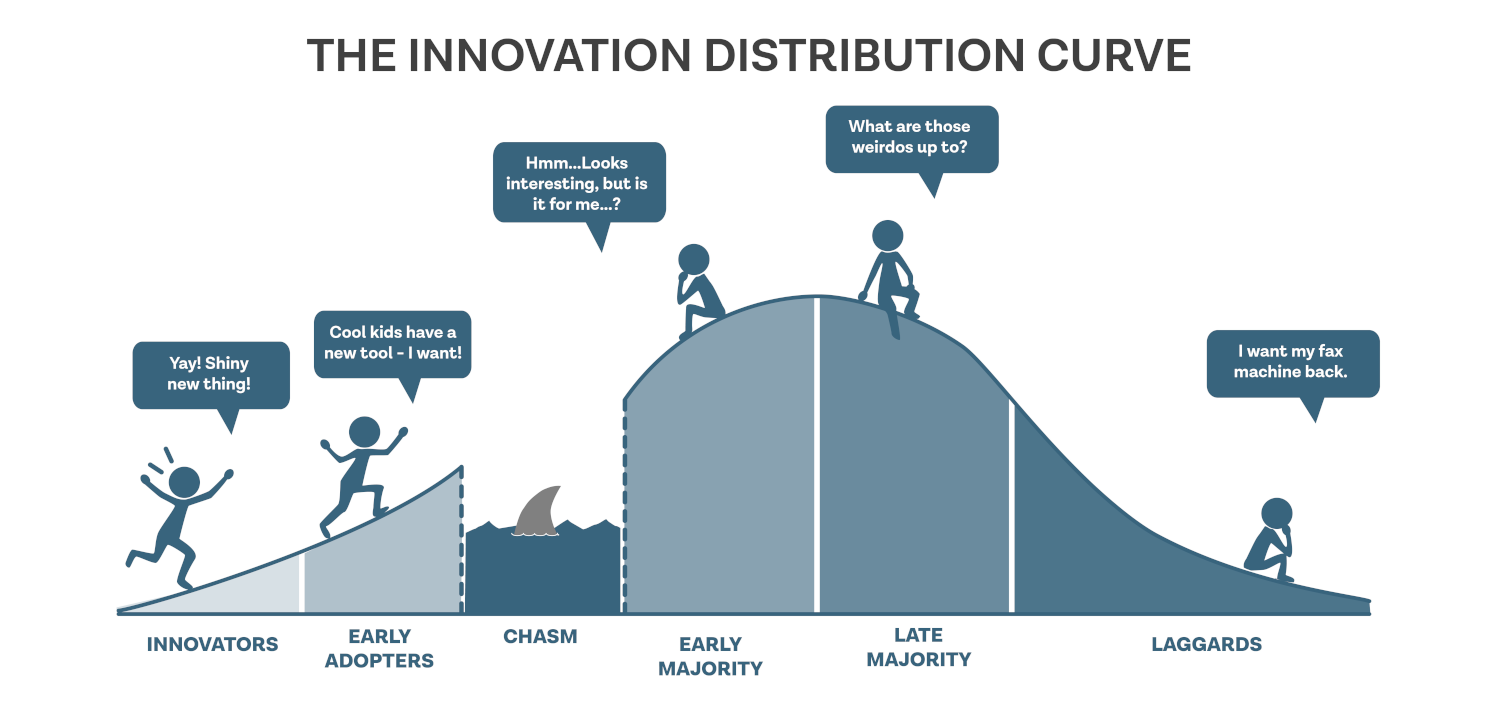
What each group needs to move forward
To successfully drive adoption, change leaders cannot rely on a single, broadcast communication. Each group experiences change through a different psychological lens. Each group needs something different to move from initial awareness to lasting commitment. How people feel about change will influence how they transition.
Innovators are risk-tolerant, enthusiastic about technology, and naturally curious. They are eager to explore new concepts simply for the sake of novelty and experimentation.
What they need:
- Early access: Unrestricted entry to beta tools, pilot programs, or draft frameworks.
- Autonomy to test: Permission to break things, discover edge cases, and explore capabilities without rigid rules.
- Psychological safety: Explicit reassurance that incomplete results or initial failures during testing are acceptable learning outcomes.
Early adopters are respected opinion leaders within their peer networks. They do not embrace change merely because it is new; they embrace it to gain a strategic advantage or solve a pressing problem.
What they need:
- Strategic vision: A clear articulation of why the change matters and the value it delivers.
- Leadership and co-creation: Opportunities to act as change champions, guide pilot programs, and shape the final implementation.
- Recognition and early proof: Metrics demonstrating that their early endorsement is generating tangible results.
The gap between early adopters and the early majority represents the most critical hurdle in any change initiative. Early adopters buy into vision and possibilities; the early majority buys into practical productivity and peer-tested reliability. Transitioning across this gap requires shifting from promotional hype to concrete, low-risk proof.
The tipping point occurs when an innovation successfully crosses the chasm. This means about 15% to 20% of people have adopted the change. This transforms an uphill, high-effort campaign into self-sustaining organisational momentum. Once an initiative crosses the chasm, social proof takes over: the pragmatic majority sees enough peer-tested reliability to buy in, shifting the cultural baseline from 'Why should we adopt this?' to 'This is now how we work'.
The early majority are pragmatic workers who are willing to change, but only after seeing evidence that the new approach is reliable and effective. They rely heavily on peer recommendations.
What they need:
- Social proof: Practical case studies, testimonials, and live demonstrations from trusted colleagues showing that the innovation works.
- Comprehensive support: Accessible user guides, step-by-step training, and responsive support channels to minimize productivity dips.
- Low-risk implementation: A structured, phased transition plan that allows them to build confidence in the new approach without threatening daily output.
The late majority are cautious pragmatists who are sceptical of innovation and risk-averse. They adopt new working methods primarily due to peer pressure, economic necessity, or official mandate.
What they need:
-
Established social norms: Clear signals from leadership and broader teams that the new tool or process is now the universal standard.
-
Frictionless interfaces: Intuitive tools and simplified workflows that require minimal extra cognitive effort.
-
Direct assistance and safety nets: One-on-one coaching and explicit instructions that protect them from making costly mistakes.
Laggards focus on tradition and stability, often guarding historical processes. They view new initiatives with deep scepticism and resist changing established routines.
What they need:
-
Removal of legacy options: Formal decommissioning of old systems, spreadsheets, or processes so returning to the old way is no longer possible.
-
Empathetic boundaries: Respect for their past contributions, paired with firm, non-negotiable expectations regarding future requirements.
-
Targeted, individualised mentoring: Direct, practical guidance focused solely on helping them meet minimum operational requirements without technical jargon.
Strategic principles for change leaders
-
Focus energy on the front of the curve: Spend early effort empowering early adopters to build momentum and create social proof rather than attempting to convince sceptics immediately.
-
Translate the message: Shift communication over time from high-level strategic vision (which appeals to early adopters) to practical, everyday workflow improvements (which reassure the early and late majority).
-
Leverage peer influence: Position early adopters as mentors and facilitators for the early majority to bridge the gap between vision and widespread operational adoption.
A toolkit for the ethical and effective use of children's information
Digital resources explore definitions, tools and examples for practitioners and data leads to strengthen children's information use.