
Information sharing decision framework
| Part of a toolkit for the ethical and effective use of children's information - practical tools.
When to share and when NOT to share information: A quick reference decision framework for multi-agency professionals
This unified decision framework aims to support multi-agency professionals to meet their duty to share information. This guide aims to reduce anxiety about when to share information and when not to share information. It is designed for local authority social care, health, education, police, and community-based partners. The purpose is to support professionals to meet their duties under:
- The Children’s Wellbeing and Schools Act 2026.
- Working together to safeguard children 2026 - statutory guidance.
- Data Sharing -Information sharing for professionals.
- Information Sharing Duty - Statutory guidance for safeguarding organisations and their practitioners.
This tool guides practitioners step-by-step through determining when sharing is required to protect a child and when sharing should be paused, restricted, or refused.
Deciding whether to share or not share information
Use this visual decision pathway whenever you are evaluating a request or deciding whether to share children's information across multi-agency boundaries.
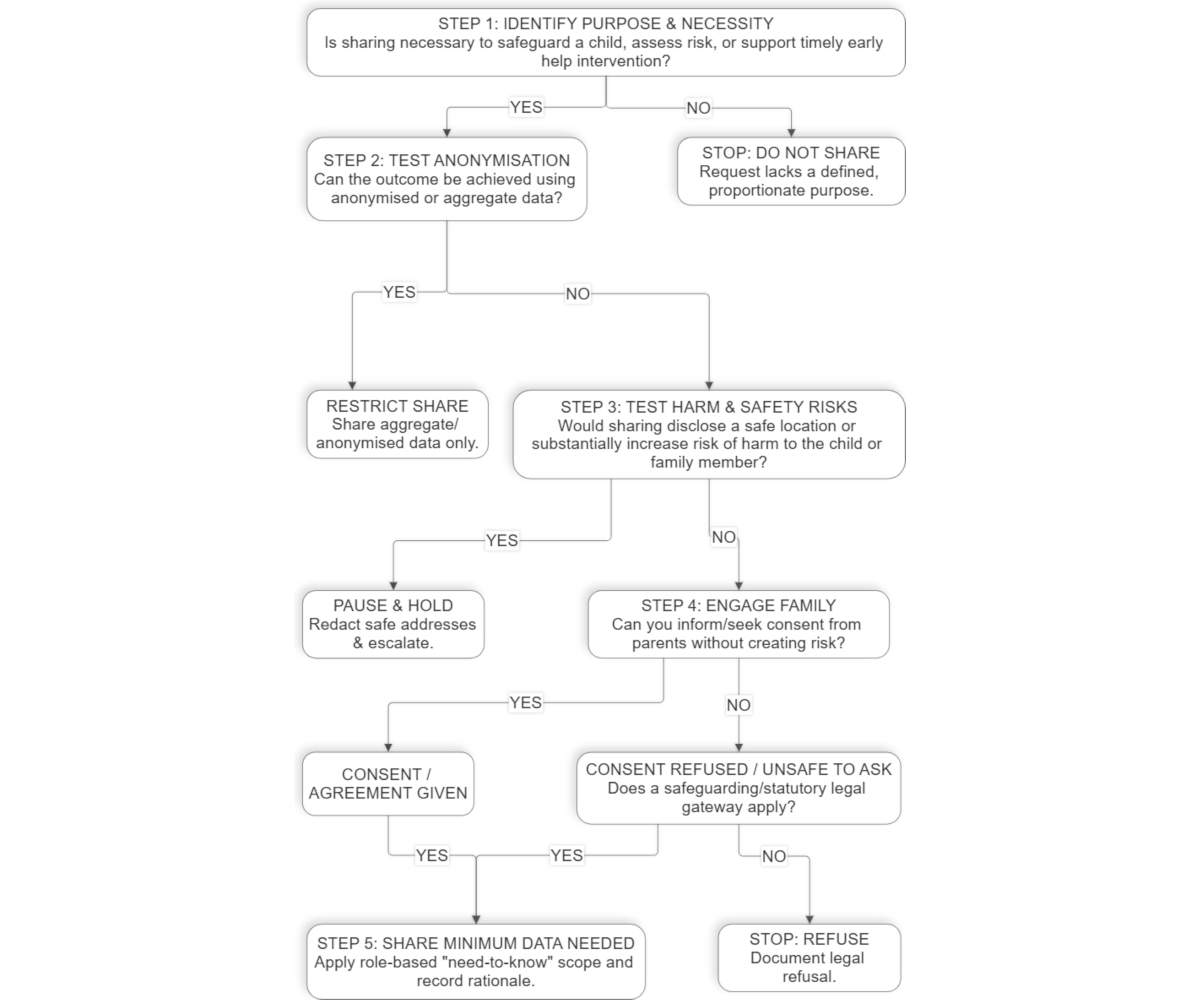
Operational rules: When to share information vs. When NOT to share information
Green light: Scenarios where information SHOULD be shared
-
Child protection and safeguarding escalation: Whenever a child is at risk of significant harm, relevant context must be shared with safeguarding leads, police, or social care.
-
Early help triage: Disclosing early indicators of family strain across health, education, and social care to coordinate early intervention before crises escalate.
-
Statutory multi-agency assessments: Sharing necessary background details for statutory reviews, Education, Health and Care Plans (EHCP), or Care Leaver Pathway Plans.
-
Overriding consent refusal: When parental consent is withheld, but sharing is required to protect a child or fulfil statutory safeguarding duties under legal gateways like public task or vital interests.
Red light / pause: Scenarios where information MUST NOT be shared (or restricted)
-
'Fishing expeditions' / Speculative requests: Requests that lack a clear, justified safeguarding or welfare outcome for the specific child.
Action: Do NOT share. -
Aggregate use cases: Commissioning, service planning, or research where population trends are needed rather than personal identity.
Action: Share anonymised/ aggregate data only. -
Safety and location exposure: Disclosing a domestic abuse refuge address, confidential whistleblower details, or safe accommodation locations.
Action: Pause, redact sensitive details, and escalate. -
Over-broad 'need-to-know' scope: Demanding unredacted historical case notes when a one-page current risk summary satisfies the recipient's role.
Action: Redact and restrict to the minimum necessary data. -
Data dumps replacing human dialogue: Transferring entire electronic case files in place of structured inter-professional conversation.
Action: Restrict file transfer; provide concise summary and schedule direct discussions.
The 8 Caldicott Principles for Children's Information
Ensure every information-sharing decision aligns with the updated Caldicott Principles:
-
Justify the purpose: Every proposed disclosure must have a defined, legitimate safeguarding or welfare goal.
-
Use personal data only when necessary: Do not use identifiable details if anonymised data works.
-
Use the minimum necessary data: Disclose only the specific fields required for the immediate decision.
-
Access on a strict 'need-to-know' basis: Restrict visibility based on the recipient's exact professional role.
-
Understand responsibilities: Ensure all handling staff are trained in data protection and ethical standards.
-
Comply with the law: Follow guidance in Working together to safeguard children 2026 - statutory guidance, and Children’s Wellbeing and Schools Act 2026.
-
The Duty to share is paramount: The duty to share information for child protection is as important as confidentiality.
-
Inform expectations (transparency): Maintain open dialogue with families about how their data is used.
Common information sharing myths
There are many myths that exist about whether information can or can’t be shared. Some examples include:
-
We cannot share information without signed parental consent
Data protection law provides legal gateways (public task, vital interests, safeguarding) beyond consent. Seek agreement where safe but proceed if child protection or welfare requires it. -
GDPR forbids sharing case notes across agencies
Data protection legislation explicitly supports proportionate sharing for safeguarding and welfare. Establish clear Information Sharing Agreements (ISAs) and share necessary context. -
We must wait for proven harm before sharing
Early help relies on sharing early indicators of strain to prevent issues from turning into crises. Proportionate information sharing across multi-agency hubs helps build a clear picture of need. -
Sharing everything protects us from liability
Transferring entire unredacted historical files violates data protection rules and creates privacy risks. Apply data minimisation principles to share only what is necessary for the specific decision.
A toolkit for the ethical and effective use of children's information
Digital resources explore definitions, tools and examples for practitioners and data leads to strengthen children's information use.